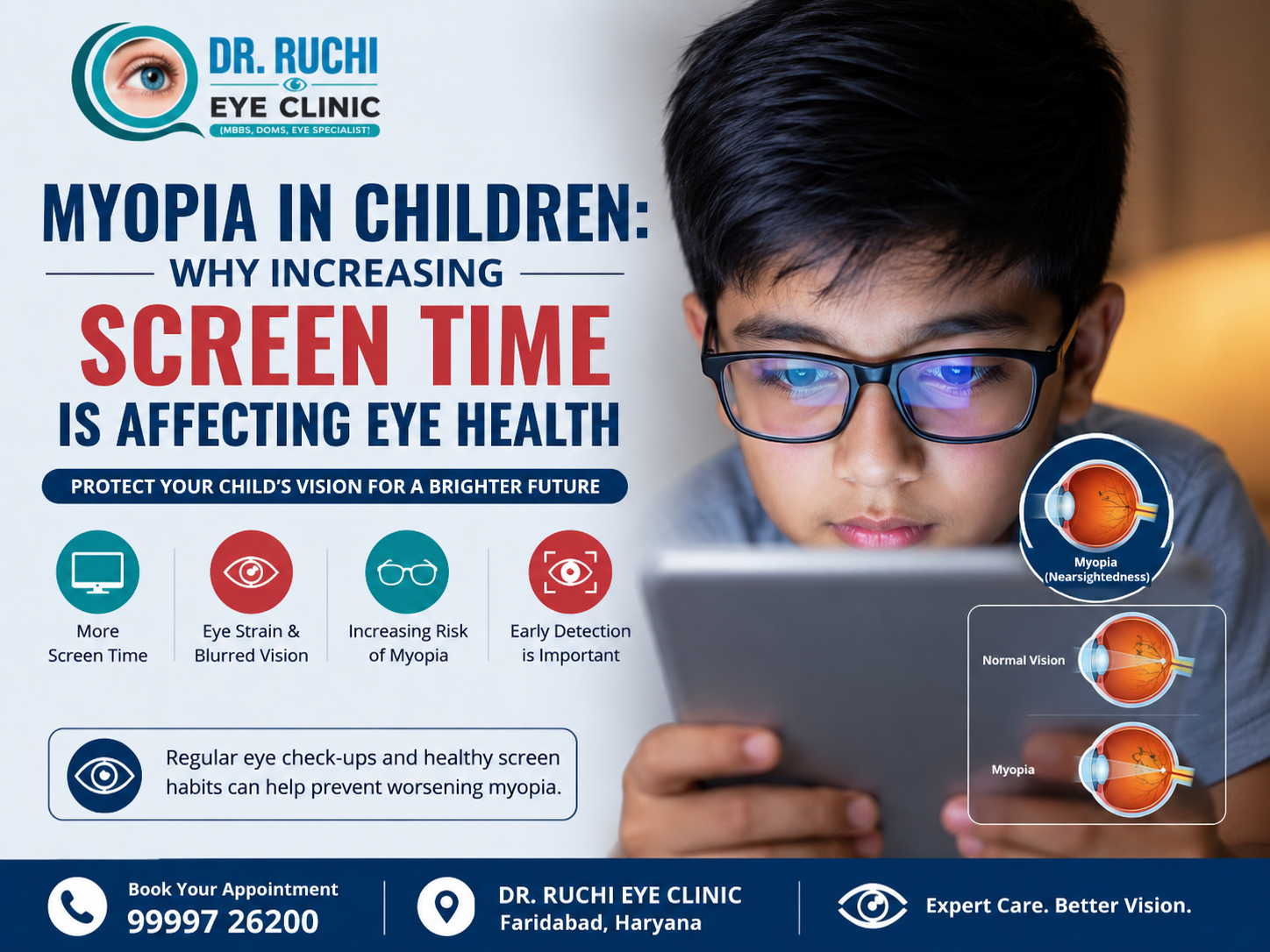
Best Eye Care Clinic in Faridabad care can help parents identify vision problems in children at an early stage. With smartphones, tablets, laptops and televisions becoming part of children’s education and entertainment, many children now spend several hours each day focusing on nearby screens. While screen time is not the only cause of myopia, prolonged near work, less outdoor activity and lifestyle changes may contribute to the development or progression of childhood myopia.
Myopia, commonly called short-sightedness, occurs when distant objects appear blurred while nearby objects can usually be seen more clearly. It often develops during childhood and may progress as the eyes continue to grow. A child may not always realise that their vision has changed, which means parents may notice signs before the child complains about poor eyesight.
For families considering Myopia Treatment in Faridabad, understanding the condition is an important first step. Myopia management is not simply about giving a child glasses. Depending on the child’s age, prescription, family history and progression, an eye-care professional may recommend regular monitoring or discuss specific approaches to help manage progressing myopia.
Dr. Ruchi provides eye-care services in Faridabad, where parents can seek professional evaluation when they notice changes in their child’s vision. An examination can determine whether blurred vision is caused by myopia or another refractive or eye-related condition.
This article explains how screen habits may affect children’s eyes, the early signs of myopia, how childhood myopia is diagnosed and what parents can do to support healthy vision.
Why Choose Dr. Ruchi – Best Eye Care Clinic in Faridabad?
Parents often look for a convenient and reliable Best Eye Care Clinic in Faridabad when their child starts showing signs of changing vision. However, selecting an eye-care professional should involve more than an online search ranking. Proper examination, clear communication, appropriate diagnosis and personalised management are important considerations.
Dr. Ruchi focuses on eye-care evaluation and patient guidance. For a child with suspected myopia, the first step is understanding the child’s symptoms and performing an appropriate eye examination before deciding on any treatment.
A local eye-care clinic can also make follow-up easier when a child needs periodic monitoring. This can be particularly relevant for children whose spectacle prescription changes as they grow.
The specific years of experience, hospital affiliation, qualifications, number of procedures and awards for Dr. Ruchi were not provided for this article. These details should be added only after verification from the doctor’s official professional profile.
Why Is Dr. Ruchi Associated With Best Eye Care Clinic in Faridabad Searches?
When parents search for a Best Eye Care Clinic in Faridabad, they are usually looking for accessible care, appropriate diagnosis and guidance they can understand. For childhood myopia, these factors are particularly important because a child’s prescription may change over time.
Dr. Ruchi can help parents understand whether a child’s symptoms are consistent with myopia or another eye condition. The treatment plan should always be based on individual clinical findings rather than assumptions about screen use alone.
Parents should consider:
- Appropriate examination for the child’s age
- Accurate assessment of refractive error
- Monitoring of changing prescriptions
- Clear explanation of examination findings
- Suitable spectacle correction when required
- Discussion of myopia-management options when appropriate
- Attention to overall eye health
- Patient safety and ethical medical care
- Follow-up recommendations
- A comfortable environment for children
What Is Myopia in Children?
Myopia develops when the eye focuses light in front of the retina instead of directly on the retina. This commonly happens when the eyeball is longer than usual, although other optical factors can also contribute.
A child with myopia may be able to read a book comfortably but have difficulty seeing the writing on a classroom board. They may squint, move closer to the television or avoid activities that require clear distance vision.
Childhood myopia can develop gradually. Because children may adapt to blurred distance vision, they may not tell their parents that something is wrong.
This makes routine vision assessment important, particularly when there is a family history of myopia or when parents notice changes in a child’s visual behaviour.
How Does Increasing Screen Time Affect Children’s Eye Health?
Screen time has become an important part of modern childhood, but the relationship between screens and myopia is more complicated than simply saying that screens cause short-sightedness.
Children who spend long periods on phones, tablets or computers may spend more time doing close-up visual work. At the same time, extensive screen use may reduce the amount of time spent outdoors. Both near-work habits and outdoor exposure are relevant factors when considering childhood myopia.
These symptoms do not automatically indicate myopia. If they continue or interfere with school and everyday activities, an eye examination is advisable.
Parents should therefore focus on a balanced routine rather than completely blaming screens for a child’s vision changes.
Long periods of screen use can also cause digital eye strain. Children may experience:
- Tired or uncomfortable eyes
- Dryness or irritation
- Headaches
- Temporary blurred vision
- Frequent eye rubbing
- Difficulty concentrating
- Reduced blinking
What Are the Early Signs of Myopia in Children?
Early identification can help parents arrange an eye examination before vision problems begin affecting everyday activities. Common signs include the following.
Squinting to See Distant Objects
Children with blurred distance vision may squint when looking at the classroom board, television or people across a room.
Sitting Too Close to Screens
A child who repeatedly moves very close to a television, computer or tablet may be having difficulty seeing clearly from a normal distance.
Difficulty Seeing the Classroom Board
Teachers may sometimes notice that a child is struggling to copy information from the board or frequently asks to sit closer.
Frequent Eye Rubbing
Eye rubbing may be caused by tiredness, dryness or irritation. If it occurs alongside other vision-related complaints, professional evaluation can be useful.
Headaches After Visual Tasks
Some children may experience headaches after reading, studying or prolonged near work. Headaches can have many causes, so they should not automatically be attributed to myopia.
Avoiding Distance-Based Activities
A child who suddenly avoids sports or games that require clear distance vision may need an eye examination.
Parents who notice these changes can consult an eye-care professional rather than waiting for the problem to become more noticeable.
When Should Children Have an Eye Check-Up in Faridabad?
A child’s vision should not be assessed only after they complain about blurred eyesight. Many children do not recognise that their vision is different from normal.
A Best Eye Care Clinic in Faridabad can provide an appropriate eye assessment and help parents understand whether further monitoring is necessary.
The frequency of follow-up depends on the child’s age, eye health, refractive error and individual risk factors. Parents should follow the schedule recommended by their eye-care professional.
An examination can be considered when a child:
- Squints frequently
- Has difficulty seeing the classroom board
- Sits very close to screens
- Complains of recurring headaches
- Rubs their eyes frequently
- Has difficulty with distance activities
- Has a family history of myopia
- Has a previous spectacle prescription
- Shows changes in school performance
- Complains about blurred or uncomfortable vision
How Is Myopia Diagnosed in Children?
Myopia diagnosis usually begins with visual-acuity testing. This helps determine how clearly the child can see objects at different distances.
The eye-care professional may then assess refractive error to determine whether the child has myopia, hyperopia or astigmatism. Other assessments may be performed to evaluate eye alignment, focusing ability and general eye health.
In younger children, specialised examination techniques may be required because they may not be able to communicate clearly about what they see. In some situations, eye drops may be used to obtain a more accurate measurement of refractive error.
Dr. Ruchi can assess the child’s symptoms and examination findings before recommending appropriate vision correction or follow-up.
An accurate diagnosis is important because not every child with blurred vision needs the same treatment.
What Is Myopia Control in Children?
Myopia control refers to approaches designed to slow the progression of myopia rather than simply correcting blurred vision.
Regular spectacles can provide clear vision, but they do not necessarily prevent myopia from progressing. For children whose myopia is changing, an eye-care professional may discuss management approaches based on age, prescription and individual risk factors.
Depending on the clinical situation, options may include specially designed spectacle lenses, certain contact-lens approaches or medically supervised eye-drop treatment.
Myopia control is not identical for every child. The most suitable approach depends on individual examination findings.
Parents should avoid buying or using products marketed for myopia control without professional guidance. Regular follow-up is often an important part of monitoring whether a child’s prescription is changing.
What Is Myopia Treatment in Faridabad for Children?
Myopia Treatment in Faridabad begins with a proper eye examination rather than immediately selecting a particular treatment.
For many children, prescription spectacles are an important part of correcting blurred distance vision. Properly prescribed glasses can help a child see the classroom board, participate in sports and perform everyday activities more comfortably.
If myopia is progressing, an eye-care professional may discuss specific myopia-management options. These approaches aim to reduce the rate of progression in appropriate children rather than simply making distant objects clearer.
Regular follow-up is important because children’s eyes continue to develop during childhood.
The treatment plan depends on several factors, including:
- Child’s age
- Current prescription
- Previous prescription changes
- Family history
- Eye health
- Rate of myopia progression
- Ability to follow the recommended treatment
How Can Parents Reduce Screen-Related Eye Strain?
Parents do not necessarily need to eliminate screens completely. Instead, they can help children develop healthier visual habits.
Encourage Regular Breaks
Children should take regular breaks during prolonged near work. Looking at something farther away can provide a break from continuous close focusing.
Maintain a Comfortable Viewing Distance
Phones, tablets and books should not be held extremely close to the face. Children should use a comfortable distance while reading or viewing screens.
Use Appropriate Lighting
The room should have comfortable lighting so the screen is not excessively bright or difficult to see.
Encourage Outdoor Activity
Regular outdoor activity is associated with a lower risk of developing childhood myopia and also supports overall physical health.
Create Balanced Screen Routines
Parents can separate educational screen use from recreational use and encourage children to spend time reading, playing, exercising and interacting with family members.
Encourage Normal Blinking
Children may blink less frequently while concentrating on a screen. Reminding them to blink normally can help reduce dryness and discomfort.
These simple habits can support children’s overall eye comfort while professional examinations address any underlying vision problem.
When Is Myopia Specialist in Faridabad Consultation Important?
A Myopia Specialist in Faridabad consultation can be considered when a child has confirmed myopia, particularly when the prescription appears to be increasing over time.
A Myopia Specialist in Faridabad can assess whether the child’s myopia is stable or progressing and explain which management options may be appropriate.
Dr. Ruchi can also help parents understand why regular monitoring may be necessary even when a child is already wearing glasses.
Parents can discuss:
- Current spectacle prescription
- Previous prescription changes
- Family history
- Outdoor activity
- Screen and near-work habits
- Possible myopia-management approaches
- Appropriate follow-up intervals
- Overall eye health
Why Do Families in Faridabad Seek Children’s Eye Care?
For families in Faridabad, having access to local children’s eye care can make regular examinations more convenient. This is particularly useful when a child needs repeated vision assessments because their prescription is changing.
A Best Eye Care Clinic in Faridabad can provide a convenient setting for discussing concerns related to school vision, screen habits, headaches, blurred distance vision and eye discomfort.
However, location should not be the only consideration. Parents should also look at the eye-care professional’s qualifications, appropriate diagnostic support and the suitability of the proposed management plan.
For families seeking Myopia Treatment in Faridabad, ongoing monitoring can be especially important because childhood myopia may change as the eyes grow.
What Are the Benefits of Choosing Dr. Ruchi?
For children with suspected or confirmed myopia, appropriate eye care can offer several practical benefits:
- Individual assessment of vision
- Identification of refractive errors
- Appropriate spectacle guidance
- Monitoring of prescription changes
- Discussion of myopia-management options
- Guidance regarding screen habits
- Advice about outdoor activity
- Clear communication with parents
- Follow-up based on the child’s needs
Dr. Ruchi can help parents understand the child’s examination findings and the reason behind any recommended follow-up.
Parents should remember that treatment decisions should be based on clinical assessment rather than promotional claims or guarantees of a particular outcome.
What Eye Conditions May Require Children’s Eye Care?
Myopia
Myopia causes blurred distance vision and commonly develops during childhood. Children may need spectacles and, in selected cases, additional myopia-management strategies.
Astigmatism
Astigmatism can cause blurred or distorted vision because of differences in the shape of the cornea or lens. It can occur together with myopia.
Hyperopia
Hyperopia, or long-sightedness, affects how the eye focuses on nearby objects. Its significance varies according to the child’s age and degree of refractive error.
Digital Eye Strain
Digital eye strain may develop after prolonged screen use and can cause dryness, tiredness, headaches and temporary visual discomfort.
Eye Alignment Problems
Some children may have difficulty keeping both eyes properly aligned. Early assessment can help identify whether further evaluation or treatment is needed.
A Best Eye Care Clinic in Faridabad can help determine whether a child’s symptoms are related to refractive error or another eye condition.
What Advanced Treatment and Management Options Are Available?
Modern children’s eye care focuses on accurate diagnosis, appropriate vision correction and individualised management.
For children with myopia, possible approaches may include:
- Prescription spectacles
- Specialised myopia-control spectacle lenses
- Selected contact-lens-based approaches
- Medically supervised eye-drop treatment in appropriate cases
- Regular monitoring of refractive changes
- Lifestyle guidance
- Advice regarding outdoor activity and screen habits
For Myopia Treatment in Faridabad, the appropriate option depends on the child’s age, prescription, eye health and progression.
Parents should not assume that the newest or most advanced treatment is automatically the most suitable. A treatment should be selected according to the child’s clinical needs and the advice of a qualified eye-care professional.
Who Should Consult an Eye-Care Professional?
Parents should consider arranging an eye examination if their child:
- Frequently squints
- Cannot see the classroom board clearly
- Sits unusually close to screens
- Experiences recurring headaches during visual tasks
- Rubs their eyes regularly
- Has difficulty with distance activities
- Has a family history of myopia
- Has already been prescribed glasses
- Shows a change in school or sports performance
- Complains about blurred vision
Children who already have myopia may also need regular follow-up to determine whether their prescription is changing.
A Myopia Specialist in Faridabad can assess the child’s visual status and help determine whether further management is required.
When Should You Seek Medical Attention?
Some eye symptoms require prompt medical evaluation rather than waiting for a routine examination.
Parents should seek medical attention if a child develops:
- Sudden loss or major reduction of vision
- Significant eye pain
- Severe redness
- Double vision
- Sudden changes in the appearance of the eye
- New flashes or floaters
- An eye injury
- Persistent or rapidly worsening blurred vision
Most childhood vision concerns are not emergencies, but sudden or severe symptoms should always be taken seriously.
Timely assessment can help identify the cause and determine whether urgent treatment is necessary.
Summary
Childhood myopia is an important eye-health concern because clear vision supports learning, reading, sports and everyday activities. Increased screen use may contribute to prolonged near work and reduced outdoor activity, but it is not accurate to consider screens the only cause of myopia.
Parents should watch for signs such as squinting, difficulty seeing the classroom board, sitting close to screens, headaches and changes in distance vision. Regular eye examinations can help identify refractive errors and monitor changes over time.
For families considering Myopia Treatment in Faridabad, an appropriate eye examination should be the starting point. Depending on the child’s condition, management may include spectacles, monitoring or specific approaches designed to slow myopia progression.
A Myopia Specialist in Faridabad can explain the child’s prescription, risk factors and available management options. Parents can also support healthy vision by encouraging outdoor activity, reasonable screen habits and regular breaks during close-up work.
Frequently Asked Questions – Best Eye Care Clinic in Faridabad
What are the early symptoms of myopia in children?
Children with myopia may squint when looking at distant objects, sit close to the television, move closer to screens or have difficulty reading the classroom board. Some children may complain of headaches or avoid activities requiring distance vision. Because children may adapt to blurred vision, they may not always report the problem themselves. If these signs continue, an eye examination can help determine whether myopia or another vision problem is responsible.
Can too much screen time cause myopia in children?
Screen time should not be considered the sole cause of childhood myopia. However, prolonged close-up work, including digital device use, can increase near visual activity. Reduced outdoor time may also be relevant. Parents can encourage regular breaks, comfortable viewing distances and outdoor activities. If a child has persistent blurred vision, headaches or difficulty seeing distant objects, a professional examination is more useful than assuming the symptoms are caused only by screen exposure.
When should I consult a Best Eye Care Clinic in Faridabad for my child?
Parents can consider an examination when a child has difficulty seeing the classroom board, frequently squints, sits unusually close to screens, complains about recurring headaches or shows a noticeable change in visual behaviour. Children with a family history of myopia may also need appropriate monitoring. A Best Eye Care Clinic in Faridabad can assess visual acuity, refractive error and other relevant aspects of eye health to determine whether further care is needed.
Does every child with myopia need myopia-control treatment?
No. Not every child with myopia requires a specific myopia-control treatment. The decision depends on the child’s age, prescription, rate of progression, family history and overall eye health. Some children may primarily require appropriate spectacles and monitoring. If the prescription is progressing, an eye-care professional may discuss additional management options. Parents should not begin myopia-control medicines, contact lenses or other specialised products without appropriate professional guidance.
How is myopia diagnosed in children?
Diagnosis usually begins with visual-acuity testing to determine how clearly a child can see at different distances. The eye-care professional may then measure refractive error and assess eye alignment, focusing ability and overall eye health. Younger children may require specialised examination techniques. In some cases, eye drops are used to obtain a more accurate measurement. A detailed examination helps distinguish myopia from other refractive errors or eye conditions that may produce similar symptoms.
What is the role of outdoor activity in childhood myopia?
Regular outdoor activity is associated with a lower risk of developing myopia in children. Spending time outdoors also supports physical activity and a balanced daily routine. Outdoor time does not replace prescribed treatment or professional eye examinations, but it can be a useful part of healthy visual habits. Parents can encourage children to combine outdoor play with reasonable screen use, adequate sleep, schoolwork and other activities rather than spending most of their free time on digital devices.
When should parents consider Myopia Treatment in Faridabad?
Parents should first arrange an eye examination when a child has symptoms of blurred distance vision or has already been diagnosed with myopia. Myopia Treatment in Faridabad may include prescription spectacles, regular monitoring or specific myopia-management approaches when clinically appropriate. The right option depends on the child’s age, prescription, eye health and rate of progression. Regular follow-up may be needed because children’s eyes continue to develop and their prescription can change over time.
Can children outgrow myopia?
Myopia generally does not simply disappear as children grow. In many cases, childhood myopia develops or progresses while the eyes continue to grow. The rate of progression differs between children. Corrective spectacles can help provide clear vision, while appropriate myopia-management strategies may be considered when progression is a concern. Regular eye examinations help monitor changes in prescription and allow the eye-care professional to adjust the management approach when necessary.
How often should a child with myopia have an eye examination?
There is no single follow-up schedule that is appropriate for every child. The recommended interval can depend on the child’s age, current prescription, previous prescription changes, eye health and treatment plan. Children with progressing myopia may require closer monitoring. Parents should follow the examination schedule recommended by their eye-care professional. Regular assessments help identify changes early and determine whether the current spectacle prescription or management approach remains appropriate.
How can parents protect their child’s eyes while using screens?
Parents can encourage regular breaks from prolonged near work, maintain a comfortable viewing distance and ensure suitable lighting. Children should also be encouraged to spend regular time outdoors and avoid holding screens extremely close to their eyes. Healthy sleep, physical activity and balanced screen routines are also important. If a child continues to experience headaches, persistent blurred vision, eye discomfort or difficulty seeing distant objects, parents should arrange an eye examination.
Conclusion – Best Eye Care Clinic in Faridabad
Myopia in children deserves attention because clear vision is important for learning, outdoor activities, sports and everyday development. Increasing screen use may be one factor associated with prolonged near work and reduced outdoor activity, but it should not be viewed as the only cause of childhood myopia.
Parents can support healthy vision by encouraging sensible screen habits, regular outdoor activity, breaks during prolonged near work and timely eye examinations. When a child develops blurred distance vision or shows signs of progressing myopia, professional assessment can help determine the cause and identify appropriate management options.
Families searching for a Best Eye Care Clinic in Faridabad can discuss their child’s symptoms and visual needs with Dr. Ruchi. With appropriate assessment and regular monitoring, parents can make informed decisions about their child’s vision and support healthy eye development throughout childhood.