Have you ever picked up your phone and noticed the words looked slightly blurry? Or perhaps you found yourself holding a newspaper farther away because reading had become difficult. Many people believe these changes are simply a normal part of getting older. While aging does affect our eyes, some vision changes should never be ignored. One condition that often begins quietly is AMD Treatment in Faridabad. It affects the macula, the central part of the retina that helps you read, recognize faces, drive, and see fine details clearly. Because the changes usually happen slowly, many people continue with their daily lives without realizing that their central vision is gradually becoming weaker. At Dr. Ruchi Eye Clinic, we often meet patients who say, “I thought I only needed new glasses.” However, after a detailed retinal examination, the real cause turns out to be Age-Related Macular Degeneration (AMD). The good news is that early diagnosis and timely AMD Treatment in Faridabad can often help slow the disease and protect the vision you still have.
Under the care of Dr. Ruchi Pahuja, patients receive comprehensive retinal evaluations using advanced imaging technology. The goal is simple—to identify problems early, explain every finding clearly, and create a personalized treatment plan that supports long-term eye health. If you are over 50 or have noticed changes in your central vision, this guide will help you understand when it is time to visit a Retina Specialist in Faridabad.
What Is Age-Related Macular Degeneration (AMD) and Why Should You Care?
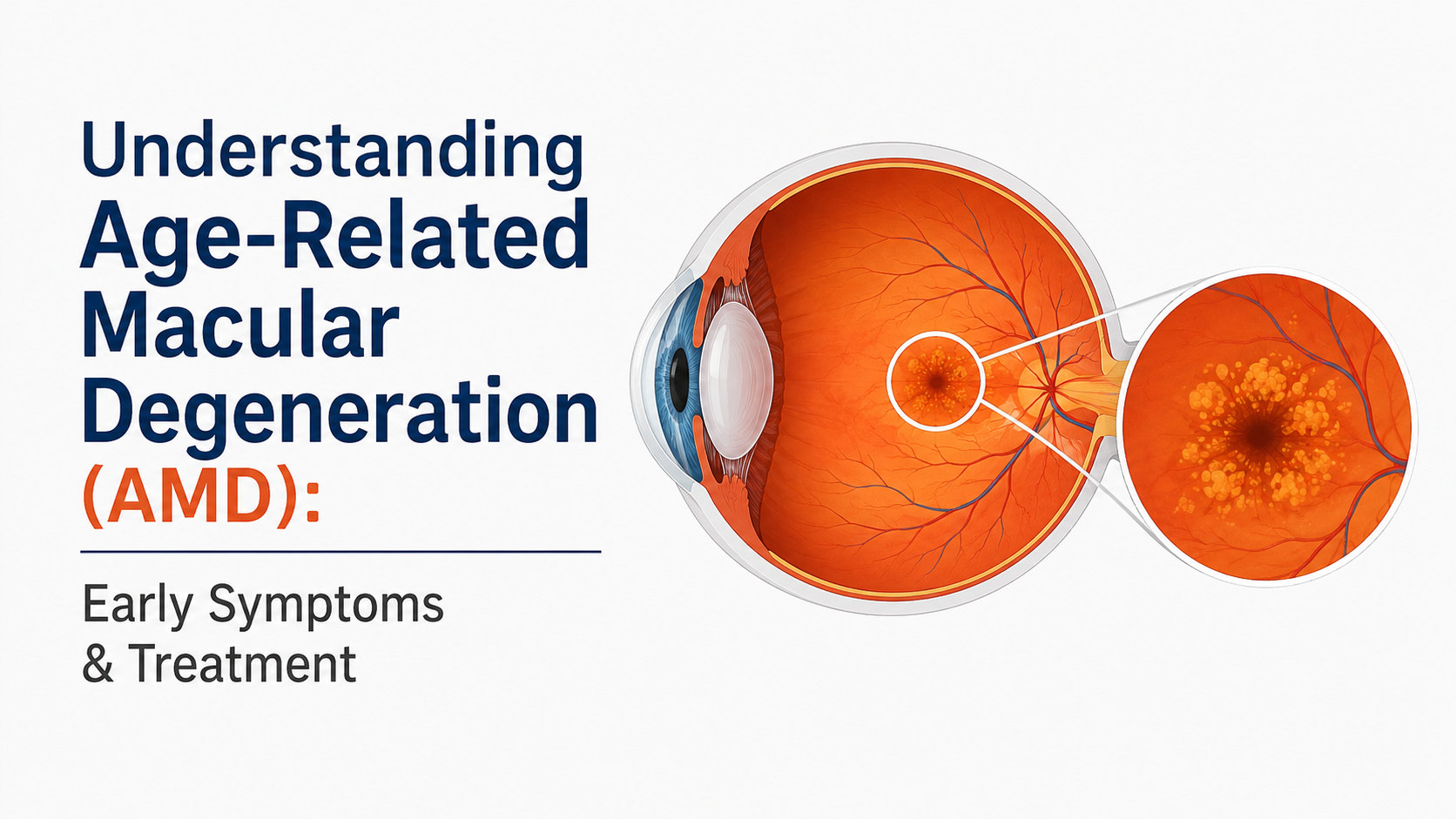
Age-Related Macular Degeneration (AMD) is a common eye disease that affects the macula, a small but very important part of the retina located at the back of your eye. The retina works like the camera sensor in a mobile phone. It captures light and sends images to your brain. The macula is responsible for sharp, detailed central vision that allows you to perform everyday tasks. When the macula becomes damaged, activities that once felt simple may gradually become challenging.
You may notice difficulty with:
- Reading books or newspapers
- Using your mobile phone
- Watching television
- Threading a needle
- Recognizing familiar faces
- Seeing traffic signs while driving
Unlike many other eye conditions, Age-Related Macular Degeneration (AMD) usually does not affect side (peripheral) vision during its early stages. This is one reason why many people delay seeking medical advice. At Dr. Ruchi Eye Clinic, patients are encouraged not to ignore these subtle changes. A timely consultation with an experienced Eye Specialist in Faridabad can help identify the cause before vision loss becomes more severe.
Why Does AMD Affect Central Vision Instead of Side Vision?
Many patients ask an important question:
“If my eyesight is changing, why can I still see things around me?”
The answer lies in the location of the disease.
The macula occupies only a small area of the retina, but it performs one of the most important jobs in vision.
It helps you:
- Read clearly
- Recognize faces
- Focus on fine details
- Drive safely
- See colors accurately
When Age-Related Macular Degeneration (AMD) damages the macula, your central vision becomes blurry or distorted, while your side vision often remains normal. Imagine looking through a clean window with a small smudge in the center. You can still see the surroundings, but the object you are trying to focus on becomes unclear.
That is exactly how many patients describe AMD. This is also why many people mistakenly believe they simply need stronger glasses. However, glasses alone cannot correct vision loss caused by damage to the macula. Early evaluation by a Retina Specialist in Faridabad can help determine whether AMD or another retinal condition is affecting your eyesight.
Could Your Blurred Vision Be More Than Just Aging?
Growing older naturally changes the eyes. Many adults require reading glasses after the age of 40, and vision may become slightly less sharp over time. However, there is an important difference between normal aging and Age-Related Macular Degeneration (AMD). Normal aging usually causes gradual changes that improve with updated glasses. AMD, on the other hand, affects the retina itself.
Ask yourself these questions:
- Are words becoming harder to read even with your glasses?
- Do you need brighter light than before?
- Are faces becoming difficult to recognize from a distance?
- Do straight lines appear slightly bent?
- Does one eye seem weaker than the other?
If your answer is “yes” to any of these questions, it is time to schedule a comprehensive eye examination. At Dr. Ruchi Eye Clinic, advanced retinal imaging allows Dr. Ruchi Pahuja to examine the macula in detail and identify early retinal changes that cannot always be seen during a routine vision check. Timely Macular Degeneration Treatment in Faridabad depends on identifying these changes as early as possible.
1. Are Straight Lines Starting to Look Wavy?
This is one of the earliest warning signs of Age-Related Macular Degeneration (AMD). Imagine reading your favorite newspaper and noticing that the printed lines no longer appear straight. Or perhaps you look at the edge of a door, a window frame, or floor tiles and realize they seem slightly bent or distorted.
You may even notice that words on your mobile phone screen appear uneven.
Many people dismiss these changes because they come and go at first.
However, distorted vision often indicates that the macula is no longer functioning normally.
The sooner these symptoms are evaluated, the greater the opportunity to protect your remaining vision.
If straight lines begin to appear wavy or distorted, do not assume it is simply because of age. A detailed retinal examination by an experienced Retina Specialist in Faridabad can identify whether Age-Related Macular Degeneration (AMD) or another retinal condition is responsible. At Dr. Ruchi Eye Clinic, patients benefit from advanced retinal imaging, careful evaluation, and personalized guidance to help preserve healthy vision for as long as possible.
2. Are You Finding It Difficult to Read Small Print?
Have you started increasing the font size on your phone? Do you hold a newspaper farther away than before? Many people think this is simply because they are getting older. While reading glasses can help with normal age-related vision changes, they cannot correct vision loss caused by Age-Related Macular Degeneration (AMD). The macula is responsible for seeing fine details. When it becomes damaged, reading becomes more difficult even if you are wearing the correct glasses.
You may notice:
- Words look faded or incomplete.
- Letters appear to move or overlap.
- Reading takes longer than before.
- You need brighter light to read comfortably.
If these problems continue, it is important to visit an Eye Specialist in Faridabad. A detailed retinal examination can determine whether AMD Treatment in Faridabad or another form of eye care is needed.
3. Do Faces Look Blurry Even When You’re Wearing Glasses?
One of the most upsetting symptoms of Age-Related Macular Degeneration (AMD) is difficulty recognizing faces. Imagine your grandchild waving at you from across the room, but you cannot clearly recognize their face until they come closer. Or perhaps you find it difficult to identify friends while shopping or attending family gatherings. Many people think their glasses need changing. However, when the macula is damaged, stronger glasses alone cannot solve the problem. At Dr. Ruchi Eye Clinic, patients often describe this symptom before receiving an accurate diagnosis. An experienced Retina Specialist in Faridabad can evaluate whether AMD or another retinal condition is affecting your central vision.
4. Is There a Dark or Empty Spot in the Center of Your Vision?
Some people with Age-Related Macular Degeneration (AMD) notice a dark, blurred, or empty area in the center of their vision. This symptom may start small and gradually become more noticeable over time.
For example, you may:
- Miss a few words while reading.
- Lose part of a person’s face while looking directly at them.
- Notice a dark patch while watching television.
- Find it difficult to focus on objects directly in front of you.
These changes should never be ignored. A comprehensive retinal examination at Dr. Ruchi Eye Clinic can help identify the cause before further vision is affected. Early Macular Degeneration Treatment in Faridabad aims to preserve the healthy vision that remains.
5. Are Colors Looking Less Bright Than Before?
Healthy eyes help us enjoy the rich colors around us. However, some people with Age-Related Macular Degeneration (AMD) notice that colors no longer appear as bright or vivid as they once did.
You might observe:
- Flowers seem dull.
- Television images look faded.
- Clothing colors appear less vibrant.
- Food looks less colorful.
These changes often happen slowly, making them easy to overlook. If colors seem unusually faded, it is worth discussing your symptoms with an Eye Specialist in Faridabad.
6. Are You Struggling to Drive at Night?
Driving at night requires clear central vision and good contrast sensitivity. When the macula becomes damaged, these abilities may gradually decline.
You may notice:
- Difficulty reading road signs.
- Increased glare from headlights.
- Trouble judging distances.
- Reduced confidence while driving after sunset.
Many people stop driving at night without understanding the real reason. A visit to Dr. Ruchi Eye Clinic can help determine whether Age-Related Macular Degeneration (AMD) is affecting your vision. Early AMD Treatment in Faridabad may help slow disease progression and support safer daily activities.
7. Why Is Everyday Work Becoming More Difficult?
Many patients first realize something is wrong because ordinary tasks suddenly require more effort. You may notice that activities you once completed easily now feel frustrating.
For example:
- Reading recipes while cooking becomes difficult.
- Sewing or knitting takes much longer.
- Watching television subtitles becomes challenging.
- Using your mobile phone feels uncomfortable.
- Shopping becomes harder because price tags appear blurred.
- Recognizing familiar faces from a distance becomes difficult.
These problems can gradually affect your independence and confidence. Many people assume they simply need stronger glasses. However, if the macula is affected, glasses alone may not restore clear vision.
Could You Have AMD Without Realizing It?
The answer is yes.
One of the biggest challenges with Age-Related Macular Degeneration (AMD) is that early stages often produce very few noticeable symptoms. Many patients continue reading, driving, and carrying out their daily routine without realizing that small changes are already occurring inside the retina. Some people discover AMD only during a routine eye examination. That is why regular retinal check-ups become increasingly important after the age of 50.
At Dr. Ruchi Eye Clinic, comprehensive retinal examinations help detect early changes before significant central vision loss develops. If you have diabetes, high blood pressure, a family history of retinal disease, or smoke regularly, routine examinations with a Retina Specialist in Faridabad become even more important. Remember, early Macular Degeneration Treatment in Faridabad cannot promise a cure, but timely diagnosis often provides the best opportunity to slow disease progression and preserve useful vision for everyday life.
Don’t Ignore the Small Changes—They Could Protect Your Future Vision
Many people believe that blurry vision is simply a part of getting older. While some vision changes are expected with age, others should never be ignored. Age-Related Macular Degeneration (AMD) often develops slowly, making it easy to miss the early warning signs. By the time daily activities become difficult, the disease may have already affected your central vision.
The encouraging news is that early diagnosis gives you the best opportunity to protect your eyesight. Although there is currently no complete cure for Age-Related Macular Degeneration (AMD), timely AMD Treatment in Faridabad can often slow its progression and help preserve the vision you still have. Regular retinal examinations, healthy lifestyle choices, and following your ophthalmologist’s advice all play an important role in long-term eye health.
At Dr. Ruchi Eye Clinic, every patient receives compassionate care from Dr. Ruchi Pahuja, who has more than 30 years of clinical experience. Using advanced retinal imaging technology and a personalized treatment approach, the clinic focuses on early diagnosis, ethical medical care, and long-term vision preservation.
If you have noticed blurred central vision, difficulty reading, wavy lines, or trouble recognizing faces, don’t wait for the symptoms to become worse. A comprehensive retinal examination at Dr. Ruchi Eye Clinic can help identify the cause early and provide the most appropriate guidance to protect your vision for the years ahead.
Frequently Asked Questions
1. What is Age-Related Macular Degeneration (AMD)?
Age-Related Macular Degeneration (AMD) is a retinal disease that affects the macula, the central part of the retina responsible for detailed vision. It can make reading, recognizing faces, and driving difficult. Early diagnosis by a Retina Specialist in Faridabad can help preserve vision.
2. What is the difference between Dry AMD and Wet AMD?
Dry AMD develops slowly as the macula becomes thinner over time. Wet AMD occurs when abnormal blood vessels grow beneath the retina and leak fluid or blood. AMD Treatment in Faridabad depends on which type of AMD is diagnosed and its stage.
3. Can AMD cause permanent vision loss?
Yes. If Age-Related Macular Degeneration (AMD) is left untreated, it can lead to permanent central vision loss. However, early diagnosis and appropriate Macular Degeneration Treatment in Faridabad can often slow disease progression and help maintain useful vision for daily activities.
4. Is AMD curable?
Currently, there is no complete cure for Age-Related Macular Degeneration (AMD). However, modern treatment options, lifestyle changes, nutritional support, and regular monitoring can help slow progression and protect the remaining vision in many patients.
5. Who is most at risk of developing AMD?
People over the age of 50, smokers, individuals with a family history of AMD, diabetes, high blood pressure, obesity, or poor dietary habits have a higher risk. Regular examinations with an Eye Specialist in Faridabad are recommended for early detection.
6. What tests are used to diagnose AMD?
Diagnosis usually includes a comprehensive eye examination, retinal evaluation, OCT Scan, and Fundus Imaging. At Dr. Ruchi Eye Clinic, these advanced investigations help Dr. Ruchi Pahuja identify early retinal changes and recommend the most appropriate treatment plan.
7. How often should older adults have their eyes examined?
Adults over 50 should have regular comprehensive eye examinations even if their vision seems normal. Those with diabetes, high blood pressure, or a family history of retinal disease may require more frequent visits to a Retina Specialist in Faridabad.
8. Can a healthy lifestyle reduce the risk of AMD?
A healthy lifestyle may help lower the risk of vision loss. Eating green leafy vegetables, exercising regularly, avoiding smoking, controlling blood pressure, managing diabetes, and protecting your eyes from excessive sunlight all support long-term retinal health alongside regular eye examinations.
9. When should I visit a Retina Specialist in Faridabad?
You should seek medical advice if you notice blurred central vision, wavy lines, dark spots, difficulty reading, trouble recognizing faces, or sudden vision changes. Early consultation with a Retina Specialist in Faridabad allows timely diagnosis and appropriate management.
10. Why should I choose Dr. Ruchi Eye Clinic for AMD care?
Dr. Ruchi Eye Clinic offers comprehensive retinal care led by Dr. Ruchi Pahuja, who has more than 30 years of clinical experience. The clinic combines advanced retinal imaging technology, personalized treatment plans, ethical medical care, and long-term follow-up to help patients protect their vision.