Author name: ankit.sabarwal@gmail.com

Uncategorized

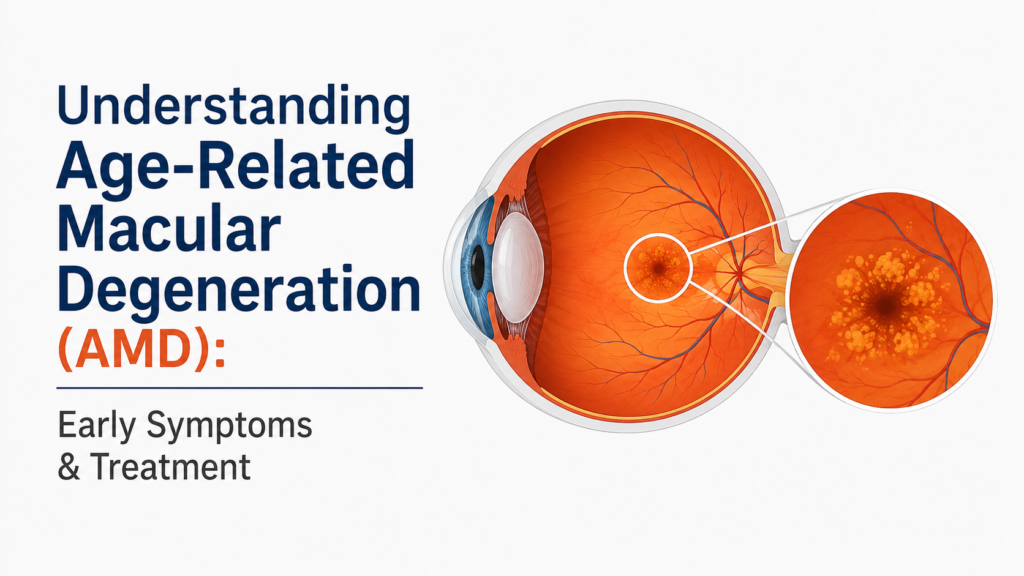
Understanding Age-Related Macular Degeneration (AMD): Early Symptoms & Treatment

Have you ever picked up your phone and noticed the words looked slightly blurry? Or perhaps you found yourself holding a newspaper farther away because reading had become difficult. Many people believe these changes are simply a normal part of getting older. While aging does affect our eyes, some vision changes should never be ignored. One condition that often begins quietly is AMD Treatment in Faridabad. It affects the macula, the central part of the retina that helps you read, recognize faces, drive, and see fine details clearly. Because the changes usually happen slowly, many people continue with their daily lives without realizing that their central vision is gradually becoming weaker. At Dr. Ruchi Eye Clinic, we often meet patients who say, “I thought I only needed new glasses.” However, after a detailed retinal examination, the real cause turns out to be Age-Related Macular Degeneration (AMD). The good news is that early diagnosis and timely AMD Treatment in Faridabad can often help slow the disease and protect the vision you still have. Under the care of Dr. Ruchi Pahuja, patients receive comprehensive retinal evaluations using advanced imaging technology. The goal is simple—to identify problems early, explain every finding clearly, and create a personalized treatment plan that supports long-term eye health. If you are over 50 or have noticed changes in your central vision, this guide will help you understand when it is time to visit a Retina Specialist in Faridabad. What Is Age-Related Macular Degeneration (AMD) and Why Should You Care? Age-Related Macular Degeneration (AMD) is a common eye disease that affects the macula, a small but very important part of the retina located at the back of your eye. The retina works like the camera sensor in a mobile phone. It captures light and sends images to your brain. The macula is responsible for sharp, detailed central vision that allows you to perform everyday tasks. When the macula becomes damaged, activities that once felt simple may gradually become challenging. You may notice difficulty with: Reading books or newspapers Using your mobile phone Watching television Threading a needle Recognizing familiar faces Seeing traffic signs while driving Unlike many other eye conditions, Age-Related Macular Degeneration (AMD) usually does not affect side (peripheral) vision during its early stages. This is one reason why many people delay seeking medical advice. At Dr. Ruchi Eye Clinic, patients are encouraged not to ignore these subtle changes. A timely consultation with an experienced Eye Specialist in Faridabad can help identify the cause before vision loss becomes more severe. Why Does AMD Affect Central Vision Instead of Side Vision? Many patients ask an important question: “If my eyesight is changing, why can I still see things around me?” The answer lies in the location of the disease. The macula occupies only a small area of the retina, but it performs one of the most important jobs in vision. It helps you: Read clearly Recognize faces Focus on fine details Drive safely See colors accurately When Age-Related Macular Degeneration (AMD) damages the macula, your central vision becomes blurry or distorted, while your side vision often remains normal. Imagine looking through a clean window with a small smudge in the center. You can still see the surroundings, but the object you are trying to focus on becomes unclear. That is exactly how many patients describe AMD. This is also why many people mistakenly believe they simply need stronger glasses. However, glasses alone cannot correct vision loss caused by damage to the macula. Early evaluation by a Retina Specialist in Faridabad can help determine whether AMD or another retinal condition is affecting your eyesight. Could Your Blurred Vision Be More Than Just Aging? Growing older naturally changes the eyes. Many adults require reading glasses after the age of 40, and vision may become slightly less sharp over time. However, there is an important difference between normal aging and Age-Related Macular Degeneration (AMD). Normal aging usually causes gradual changes that improve with updated glasses. AMD, on the other hand, affects the retina itself. Ask yourself these questions: Are words becoming harder to read even with your glasses? Do you need brighter light than before? Are faces becoming difficult to recognize from a distance? Do straight lines appear slightly bent? Does one eye seem weaker than the other? If your answer is “yes” to any of these questions, it is time to schedule a comprehensive eye examination. At Dr. Ruchi Eye Clinic, advanced retinal imaging allows Dr. Ruchi Pahuja to examine the macula in detail and identify early retinal changes that cannot always be seen during a routine vision check. Timely Macular Degeneration Treatment in Faridabad depends on identifying these changes as early as possible. 1. Are Straight Lines Starting to Look Wavy? This is one of the earliest warning signs of Age-Related Macular Degeneration (AMD). Imagine reading your favorite newspaper and noticing that the printed lines no longer appear straight. Or perhaps you look at the edge of a door, a window frame, or floor tiles and realize they seem slightly bent or distorted. You may even notice that words on your mobile phone screen appear uneven. Many people dismiss these changes because they come and go at first. However, distorted vision often indicates that the macula is no longer functioning normally. The sooner these symptoms are evaluated, the greater the opportunity to protect your remaining vision. If straight lines begin to appear wavy or distorted, do not assume it is simply because of age. A detailed retinal examination by an experienced Retina Specialist in Faridabad can identify whether Age-Related Macular Degeneration (AMD) or another retinal condition is responsible. At Dr. Ruchi Eye Clinic, patients benefit from advanced retinal imaging, careful evaluation, and personalized guidance to help preserve healthy vision for as long as possible. 2. Are You Finding It Difficult to Read Small Print? Have you started increasing the font size on your phone? Do you hold a newspaper farther away than before? Many people think this is simply because they are getting older. While reading glasses can help with normal age-related vision changes, they cannot correct vision loss
Uncategorized

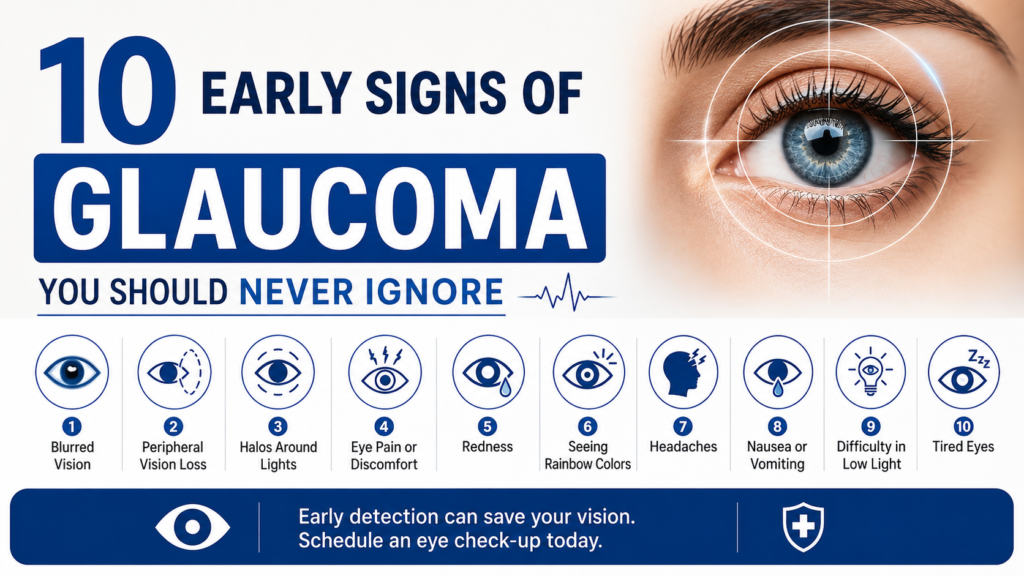
10 Early Signs of Glaucoma You Should Never Ignore

Imagine waking up every morning, reading your phone, driving to work, or watching your children play without noticing that your eyesight is slowly changing. Everything seems normal because your central vision is still clear. However, around the edges, your vision may already be disappearing little by little. This is exactly why glaucoma is often called the “Silent Thief of Sight.” It usually develops without pain and without obvious warning signs. Many people only discover the disease after permanent vision loss has already occurred. The most worrying part is that vision lost due to glaucoma cannot usually be restored. The good news is that early diagnosis can help slow or prevent further vision loss. That’s why regular Glaucoma Treatment in Faridabad begins with timely eye examinations and proper diagnostic testing. At Dr. Ruchi Eye Clinic, patients receive comprehensive glaucoma evaluations using modern diagnostic technology under the guidance of Dr. Ruchi Pahuja, who has more than 30 years of clinical experience in ophthalmology. The clinic focuses on early detection, personalized care, and long-term monitoring to help protect healthy vision. If you have ever delayed an Eye Check-up in Faridabad because your eyes “feel fine,” this article is for you. What Is Glaucoma and Why Do So Many People Miss It? Glaucoma is a group of eye diseases that damage the optic nerve, which carries visual information from your eyes to your brain. Most people think that glaucoma always causes pain or sudden blindness. In reality, the most common type develops very slowly. During the early stages, you may continue reading, driving, and working without realizing that your side vision is gradually disappearing. That is why thousands of people discover glaucoma only after significant vision has already been lost. Many patients tell us: “I thought my eyesight was normal.” “I didn’t notice anything unusual.” “I only came because someone asked me to get my eyes checked.” Unfortunately, glaucoma often gives people very little warning. Regular visits to an Eye Specialist in Faridabad are one of the best ways to identify glaucoma before it causes permanent damage. Why Is Glaucoma Called the Silent Thief of Sight? Think about locking your home every night. If someone quietly removed one brick every day, you probably wouldn’t notice at first. Weeks later, the wall would become weak, even though everything looked normal in the beginning. Glaucoma behaves in a similar way. Instead of suddenly affecting your vision, it slowly damages the optic nerve over time. Your brain naturally adjusts to the gradual vision loss. As a result, many people never realize anything is wrong until the disease has already reached an advanced stage. This is why delaying Glaucoma Treatment in Faridabad can be risky. Without early diagnosis: Side vision slowly disappears. Daily activities become difficult. Driving becomes less safe. Reading may become harder. Permanent blindness may eventually occur. The reassuring news is that regular eye examinations can detect glaucoma before these serious problems develop. At Dr. Ruchi Eye Clinic, modern investigations such as OCT Scan, Eye Pressure Testing, Visual Field Testing, and Fundus Imaging help identify glaucoma during its earliest stages. Could You Have Glaucoma Without Knowing It? The simple answer is yes. Many patients with glaucoma experience no symptoms for several years. You may continue your normal routine while the disease quietly damages your optic nerve. Ask yourself these questions: Do you often bump into objects beside you? Have you started turning your head more while walking? Do you struggle to notice people approaching from the side? Does driving at night feel different than before? Have family members mentioned that you seem to miss things around you? These changes are often very gradual, making them easy to ignore. That is why Glaucoma Treatment in Faridabad always begins with proper diagnosis rather than waiting for symptoms to become severe. If you are above 40 years of age, have diabetes, high blood pressure, or a family history of glaucoma, scheduling an Eye Check-up in Faridabad is one of the most important steps you can take to protect your vision. 1. Are You Slowly Losing Your Side Vision? This is one of the earliest and most common signs of glaucoma. Unlike blurred central vision, side vision usually disappears so gradually that people rarely notice the change. Imagine walking through your home and occasionally brushing against a chair. Or driving and failing to notice a vehicle approaching from the side. These situations may seem unimportant at first. However, they could indicate that your peripheral vision is becoming smaller. Many patients only realize this after the condition has progressed. If you notice changes in your side vision, do not ignore them. A comprehensive examination by an experienced Glaucoma Specialist in Faridabad can identify the cause before more vision is affected. 2. Do You Frequently Experience Blurred Vision? Blurred vision does not always mean you need stronger glasses. Sometimes it may be related to glaucoma or another eye condition affecting the optic nerve. Perhaps you notice that reading becomes difficult during the evening. Maybe road signs look unclear while driving. Or your eyes take longer to focus after using a computer. Although blurred vision has many possible causes, it should never be ignored. At Dr. Ruchi Eye Clinic, every patient receives a detailed examination to determine whether glaucoma, cataracts, refractive errors, retinal disease, or another condition is responsible for the symptoms. Early diagnosis allows Glaucoma Treatment in Faridabad to begin before permanent vision loss develops. 3. Do You See Halos Around Lights at Night? Have you ever looked at a streetlight or the headlights of an oncoming vehicle and noticed colorful rings around the light? Occasional halos may occur for several reasons. However, when they appear repeatedly or are associated with eye pain, blurred vision, or headaches, they should be evaluated promptly. Some types of glaucoma can increase eye pressure rapidly and produce symptoms such as: Halos around lights Blurred vision Eye pain Nausea Severe headache These symptoms require immediate medical attention. Visiting an Eye Specialist in Faridabad without delay can help prevent serious damage to the optic nerve. At Dr. Ruchi Eye Clinic, advanced glaucoma investigations help determine whether elevated eye pressure or another eye condition is causing

Scroll to Top