
Author name: drruchieyeclinicfaridabad@gmail.com

Uncategorized

Eye Allergies vs Eye Infection: How to Tell the Difference

Red, itchy, watery, or swollen eyes are common problems that many people experience at some point in their lives. However, it is not always easy to know whether these symptoms are caused by an eye allergy or an eye infection. Although both conditions may look similar in the beginning, they have different causes, treatments, and possible complications. Understanding the difference can help you seek timely medical care and protect your vision. Eye allergies occur when your immune system reacts to allergens such as pollen, dust, pet dander, or smoke. Eye infections, on the other hand, are caused by bacteria, viruses, fungi, or other microorganisms. Using the wrong treatment can sometimes worsen the condition or delay recovery. If you are experiencing persistent eye redness, irritation, discharge, or swelling, it is important to consult an experienced eye specialist for an accurate diagnosis. Patients looking for the Best Eye care center in Faridabad often visit Dr. Ruchi for detailed eye examinations and patient-focused care. With advanced diagnostic technology and over 30 years of clinical experience, Dr. Ruchi evaluates each patient carefully to determine the exact cause of their symptoms. Early diagnosis not only provides relief but also helps prevent complications that may affect your vision. Whether you require treatment for allergies, infections, or another eye condition, timely consultation is essential. Patients seeking Eye Allergy Treatment in Faridabad can benefit from a thorough evaluation and evidence-based treatment plan tailored to their individual needs. Dr. Ruchi – Eye Specialist with 30+ Years of Clinical Experience When it comes to maintaining healthy vision, choosing an experienced eye specialist makes a significant difference. Dr. Ruchi has more than 30 years of clinical experience in diagnosing and managing a wide range of eye conditions in patients of all age groups. Her approach focuses on identifying the root cause of the problem rather than simply treating symptoms. Patients searching for the Best Eye care center in Faridabad appreciate Dr. Ruchi’s commitment to providing accurate diagnosis using advanced eye diagnostic technology. Every patient receives a detailed eye examination, allowing treatment decisions to be based on clinical findings rather than assumptions. Some reasons why patients choose Dr. Ruchi include: More than 30 years of clinical experience Advanced eye diagnostic equipment Personalized treatment plans Comprehensive eye care for children and adults Compassionate and patient-centered care Evidence-based treatment approach Focus on long-term eye health Modern diagnostic techniques for accurate evaluation Whether your symptoms are caused by allergies, infections, dry eyes, or other eye disorders, Dr. Ruchi ensures that every patient receives appropriate guidance and treatment. Patients looking for Eye Allergy Treatment in Faridabad often consult her for accurate diagnosis and effective management of allergic eye conditions. Eye Allergies vs Eye Infection: Understanding the Difference Eye allergies and eye infections often produce similar symptoms, making it difficult to identify the exact cause without a proper eye examination. While both conditions can cause redness, watering, irritation, and swelling, their causes, treatment methods, and recovery timelines are quite different. An eye allergy occurs when the immune system reacts to harmless substances such as pollen, dust mites, pet dander, mold, or smoke. These allergens trigger inflammation, leading to itching and watery eyes. An eye infection develops when bacteria, viruses, fungi, or parasites invade the eye tissues. Depending on the cause, infections may spread from one person to another and often require medical treatment. Understanding these differences helps patients avoid self-medication and seek timely medical advice. Patients visiting the Best Eye care center in Faridabad receive a detailed eye examination to identify the exact cause of their symptoms before treatment begins. Symptoms of Eye Allergies Eye allergies usually affect both eyes and often occur after exposure to allergens. Common symptoms include: Persistent itching Watery eyes Redness Burning sensation Puffy eyelids Increased tearing Sensitivity to light Clear watery discharge People with allergic rhinitis, asthma, or eczema may have a higher chance of developing eye allergies. Patients seeking Eye Allergy Treatment in Faridabad are often advised to identify and avoid allergy triggers in addition to receiving appropriate medication. Symptoms of Eye Infection Unlike allergies, eye infections may affect one or both eyes and are more likely to produce discharge. Common symptoms include: Eye redness Yellow, white, or green discharge Sticky eyelids, especially after sleep Pain or soreness Swollen eyelids Blurred vision Watering Sensitivity to light Foreign body sensation Some viral infections are highly contagious and can spread through direct contact, contaminated towels, or touching the eyes with unclean hands. Patients experiencing these symptoms should visit the Best Eye care center in Faridabad for an accurate diagnosis instead of using over-the-counter eye drops without medical advice. Eye Allergy vs Eye Infection: Key Differences Eye Allergy Eye Infection Caused by allergens Caused by bacteria, viruses, fungi, or parasites Usually affects both eyes May affect one or both eyes Severe itching is common Pain and tenderness are more common Clear watery discharge Thick yellow, green, or white discharge Not contagious Some infections are contagious Often seasonal Can occur at any time Improves after avoiding allergens Usually requires medical treatment Although these differences provide useful clues, only a detailed eye examination can confirm the diagnosis. What Causes Eye Allergies? Eye allergies develop when the body’s immune system reacts to substances that are generally harmless. Common allergy triggers include: Pollen Seasonal pollen from trees, grasses, and weeds is one of the most common causes of allergic conjunctivitis. Dust Mites Dust mites found in mattresses, carpets, and upholstery may trigger year-round eye allergies. Pet Dander Tiny skin flakes from cats and dogs can cause itching, watering, and redness. Mold Spores Exposure to mold in damp environments may lead to allergic eye symptoms. Smoke and Air Pollution Vehicle pollution, cigarette smoke, and chemical fumes can irritate sensitive eyes. Cosmetics and Contact Lens Solutions Some beauty products or eye care products may trigger allergic reactions in susceptible individuals. Patients receiving Eye Allergy Treatment in Faridabad are often advised to identify these triggers to reduce future allergy episodes. What Causes Eye Infections? Understanding the Risk Factors Eye infections
Uncategorized

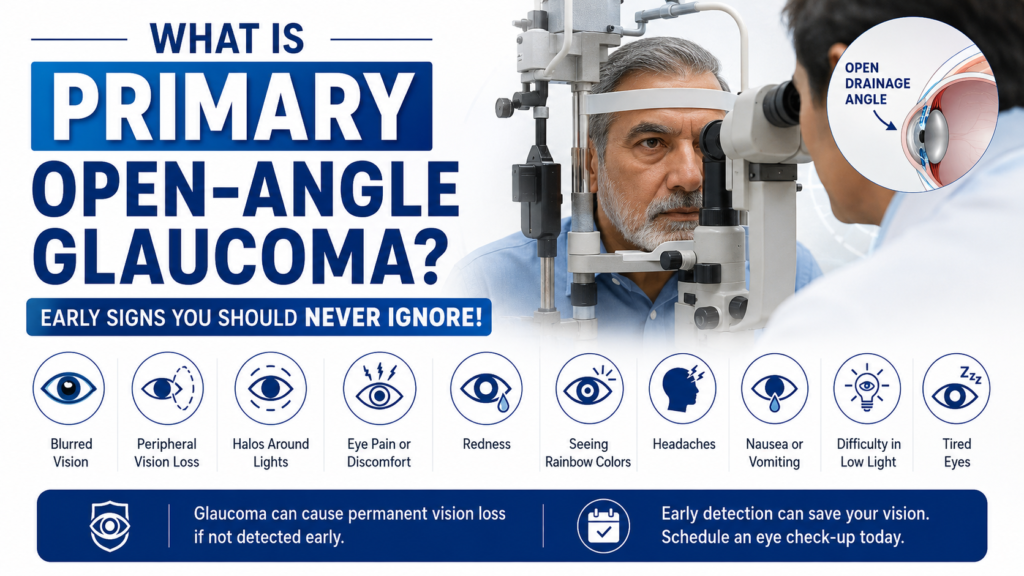
What is Primary Open-Angle Glaucoma? Early Signs You Should Never

Primary Open-Angle Glaucoma Treatment in Faridabad is essential for protecting your vision and preventing permanent blindness. Primary Open-Angle Glaucoma (POAG) is one of the most common types of glaucoma and often develops gradually without causing noticeable symptoms in its early stages. Because vision loss occurs slowly, many people remain unaware of the condition until significant damage has already occurred. Dr. Ruchi Pahuja, one of the most experienced Eye Specialists in Faridabad, provides advanced diagnosis and comprehensive treatment for glaucoma using modern eye diagnostic technology. With over 30 years of clinical experience, Dr. Ruchi Eye Clinic is committed to helping patients preserve their eyesight through early detection, personalized treatment, and compassionate eye care. Best Eye Specialist in Faridabad – Dr. Ruchi Pahuja When patients search for the Best Eye Specialist in Faridabad, they look for an experienced ophthalmologist who can diagnose complex eye conditions at an early stage and provide effective long-term treatment. Dr. Ruchi Pahuja has more than 30 years of clinical experience in comprehensive eye care and has earned the trust of thousands of patients through her expertise, ethical approach, and patient-first care. At Dr. Ruchi Eye Clinic, every patient receives a detailed eye examination using advanced diagnostic technology to identify eye diseases before they progress. From routine eye check-ups to the management of glaucoma, cataracts, diabetic retinopathy, retinal disorders, and dry eye disease, Dr. Ruchi Pahuja provides personalized treatment plans designed to protect and improve vision. Patients choose Dr. Ruchi Pahuja because of her: 30+ Years of Clinical Experience Advanced Eye Diagnostic Technology Personalized Treatment Plans Comprehensive Eye Care for All Ages Compassionate & Patient-Centred Approach Her commitment to clinical excellence and modern ophthalmology has made Dr. Ruchi Eye Clinic one of the trusted destinations for advanced eye care in Faridabad. What is Primary Open-Angle Glaucoma? Primary Open-Angle Glaucoma Treatment in Faridabad begins with understanding this serious eye condition. Primary Open-Angle Glaucoma is a chronic eye disease in which damage occurs to the optic nerve, usually due to increased pressure inside the eye. The optic nerve carries visual information from the eye to the brain, and any damage to it can lead to gradual and irreversible vision loss. Unlike other eye conditions that cause pain or sudden symptoms, Primary Open-Angle Glaucoma develops slowly over many years. Most patients do not notice any changes in their vision during the early stages, which is why glaucoma is often called the “Silent Thief of Sight.” If left untreated, glaucoma may eventually cause permanent loss of peripheral vision and, in advanced stages, complete blindness. Fortunately, early diagnosis and timely treatment can slow disease progression and help preserve vision. Why is Primary Open-Angle Glaucoma Dangerous? Primary Open-Angle Glaucoma Treatment in Faridabad is important because vision loss caused by glaucoma cannot be reversed. Once the optic nerve becomes damaged, the lost vision cannot be restored. However, early diagnosis allows doctors to slow or stop further damage through appropriate treatment. The biggest challenge with glaucoma is that many patients continue their normal daily activities without realizing their eyesight is gradually deteriorating. By the time symptoms become noticeable, significant vision loss may have already occurred. This is why regular comprehensive eye examinations are strongly recommended, especially for people over the age of 40 or those with risk factors for glaucoma. Early Signs of Primary Open-Angle Glaucoma You Should Never Ignore One of the reasons glaucoma is difficult to detect is that it usually does not cause pain or obvious symptoms during its early stages. However, some warning signs may appear as the disease progresses. Common early signs include: Gradual loss of peripheral (side) vision Difficulty seeing objects from the side Frequent changes in eyeglass prescription Blurred vision in advanced stages Difficulty adjusting to dim lighting Trouble driving, especially at night Seeing tunnel vision in later stages If you notice any of these symptoms, it is important to consult an experienced eye specialist as soon as possible. What Causes Primary Open-Angle Glaucoma? Primary Open-Angle Glaucoma Treatment in Faridabad focuses on identifying the underlying cause and controlling eye pressure before permanent vision damage occurs. Normally, a clear fluid called aqueous humor circulates inside the eye and drains through a natural drainage system. In Primary Open-Angle Glaucoma, this drainage becomes less efficient over time, causing fluid to build up inside the eye. As eye pressure gradually increases, it damages the optic nerve. In some patients, optic nerve damage may also occur even when eye pressure remains within the normal range, making regular eye examinations even more important. Who is at Risk of Primary Open-Angle Glaucoma? Although glaucoma can affect anyone, certain individuals have a higher risk of developing the condition. Risk factors include: Age above 40 years Family history of glaucoma High eye pressure Diabetes High blood pressure Severe nearsightedness (Myopia) Long-term use of steroid medications Previous eye injuries People with one or more of these risk factors should undergo regular eye examinations for early detection. How is Primary Open-Angle Glaucoma Diagnosed? Primary Open-Angle Glaucoma Treatment in Faridabad starts with a comprehensive eye examination performed by an experienced ophthalmologist. At Dr. Ruchi Eye Clinic, advanced diagnostic technology is used to accurately detect glaucoma, even in its earliest stages. Diagnostic tests may include: Comprehensive Eye Examination Eye Pressure Test (Tonometry) Optic Nerve Evaluation Visual Field Test OCT (Optical Coherence Tomography) Fundus Examination Corneal Thickness Measurement (when required) Early diagnosis allows treatment to begin before significant vision loss occurs, greatly improving long-term outcomes. Treatment Options for Primary Open-Angle Glaucoma Primary Open-Angle Glaucoma Treatment in Faridabad focuses on reducing eye pressure and preventing further damage to the optic nerve. Although glaucoma cannot be completely cured and vision already lost cannot be restored, timely treatment can slow the progression of the disease and help preserve remaining eyesight. At Dr. Ruchi Eye Clinic, Dr. Ruchi Pahuja recommends a personalized treatment plan based on the severity of glaucoma, the patient’s eye pressure, optic nerve condition, and overall eye health. Treatment options may include: Prescription eye drops to reduce intraocular pressure Oral medications when required

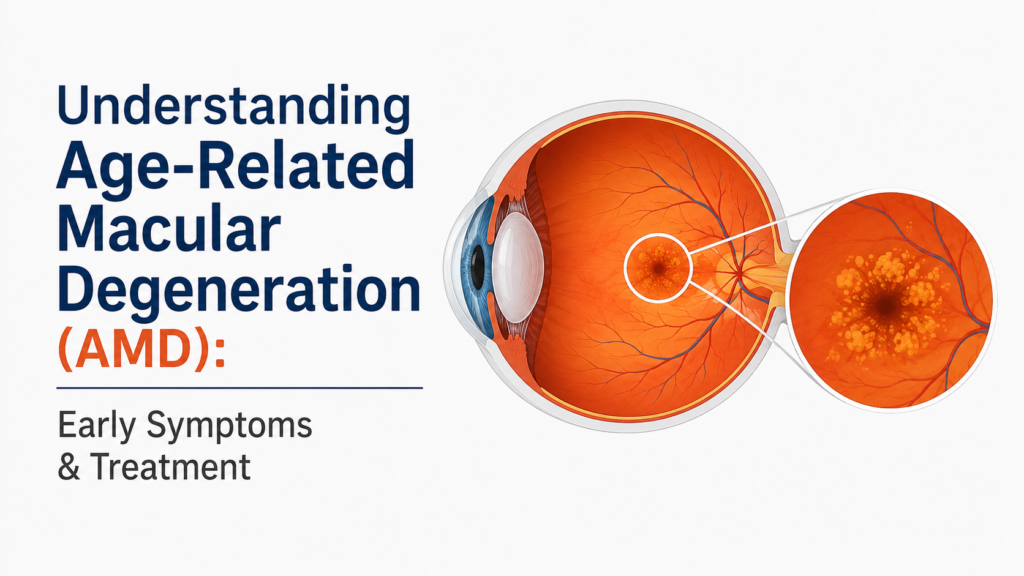
Age-Related Macular Degeneration (AMD) eye disease illustration showing retinal damage, early symptoms and treatment by Dr. Ruchi Eye Clinic Faridabad
Uncategorized

Understanding Age-Related Macular Degeneration (AMD): Early Symptoms & Treatment

Have you ever picked up your phone and noticed the words looked slightly blurry? Or perhaps you found yourself holding a newspaper farther away because reading had become difficult. Many people believe these changes are simply a normal part of getting older. While aging does affect our eyes, some vision changes should never be ignored. One condition that often begins quietly is AMD Treatment in Faridabad. It affects the macula, the central part of the retina that helps you read, recognize faces, drive, and see fine details clearly. Because the changes usually happen slowly, many people continue with their daily lives without realizing that their central vision is gradually becoming weaker. At Dr. Ruchi Eye Clinic, we often meet patients who say, “I thought I only needed new glasses.” However, after a detailed retinal examination, the real cause turns out to be Age-Related Macular Degeneration (AMD). The good news is that early diagnosis and timely AMD Treatment in Faridabad can often help slow the disease and protect the vision you still have. Under the care of Dr. Ruchi Pahuja, patients receive comprehensive retinal evaluations using advanced imaging technology. The goal is simple—to identify problems early, explain every finding clearly, and create a personalized treatment plan that supports long-term eye health. If you are over 50 or have noticed changes in your central vision, this guide will help you understand when it is time to visit a Retina Specialist in Faridabad. What Is Age-Related Macular Degeneration (AMD) and Why Should You Care? Age-Related Macular Degeneration (AMD) is a common eye disease that affects the macula, a small but very important part of the retina located at the back of your eye. The retina works like the camera sensor in a mobile phone. It captures light and sends images to your brain. The macula is responsible for sharp, detailed central vision that allows you to perform everyday tasks. When the macula becomes damaged, activities that once felt simple may gradually become challenging. You may notice difficulty with: Reading books or newspapers Using your mobile phone Watching television Threading a needle Recognizing familiar faces Seeing traffic signs while driving Unlike many other eye conditions, Age-Related Macular Degeneration (AMD) usually does not affect side (peripheral) vision during its early stages. This is one reason why many people delay seeking medical advice. At Dr. Ruchi Eye Clinic, patients are encouraged not to ignore these subtle changes. A timely consultation with an experienced Eye Specialist in Faridabad can help identify the cause before vision loss becomes more severe. Why Does AMD Affect Central Vision Instead of Side Vision? Many patients ask an important question: “If my eyesight is changing, why can I still see things around me?” The answer lies in the location of the disease. The macula occupies only a small area of the retina, but it performs one of the most important jobs in vision. It helps you: Read clearly Recognize faces Focus on fine details Drive safely See colors accurately When Age-Related Macular Degeneration (AMD) damages the macula, your central vision becomes blurry or distorted, while your side vision often remains normal. Imagine looking through a clean window with a small smudge in the center. You can still see the surroundings, but the object you are trying to focus on becomes unclear. That is exactly how many patients describe AMD. This is also why many people mistakenly believe they simply need stronger glasses. However, glasses alone cannot correct vision loss caused by damage to the macula. Early evaluation by a Retina Specialist in Faridabad can help determine whether AMD or another retinal condition is affecting your eyesight. Could Your Blurred Vision Be More Than Just Aging? Growing older naturally changes the eyes. Many adults require reading glasses after the age of 40, and vision may become slightly less sharp over time. However, there is an important difference between normal aging and Age-Related Macular Degeneration (AMD). Normal aging usually causes gradual changes that improve with updated glasses. AMD, on the other hand, affects the retina itself. Ask yourself these questions: Are words becoming harder to read even with your glasses? Do you need brighter light than before? Are faces becoming difficult to recognize from a distance? Do straight lines appear slightly bent? Does one eye seem weaker than the other? If your answer is “yes” to any of these questions, it is time to schedule a comprehensive eye examination. At Dr. Ruchi Eye Clinic, advanced retinal imaging allows Dr. Ruchi Pahuja to examine the macula in detail and identify early retinal changes that cannot always be seen during a routine vision check. Timely Macular Degeneration Treatment in Faridabad depends on identifying these changes as early as possible. 1. Are Straight Lines Starting to Look Wavy? This is one of the earliest warning signs of Age-Related Macular Degeneration (AMD). Imagine reading your favorite newspaper and noticing that the printed lines no longer appear straight. Or perhaps you look at the edge of a door, a window frame, or floor tiles and realize they seem slightly bent or distorted. You may even notice that words on your mobile phone screen appear uneven. Many people dismiss these changes because they come and go at first. However, distorted vision often indicates that the macula is no longer functioning normally. The sooner these symptoms are evaluated, the greater the opportunity to protect your remaining vision. If straight lines begin to appear wavy or distorted, do not assume it is simply because of age. A detailed retinal examination by an experienced Retina Specialist in Faridabad can identify whether Age-Related Macular Degeneration (AMD) or another retinal condition is responsible. At Dr. Ruchi Eye Clinic, patients benefit from advanced retinal imaging, careful evaluation, and personalized guidance to help preserve healthy vision for as long as possible. 2. Are You Finding It Difficult to Read Small Print? Have you started increasing the font size on your phone? Do you hold a newspaper farther away than before? Many people think this is simply because they are getting older. While reading glasses can help with normal age-related vision changes, they cannot correct vision loss

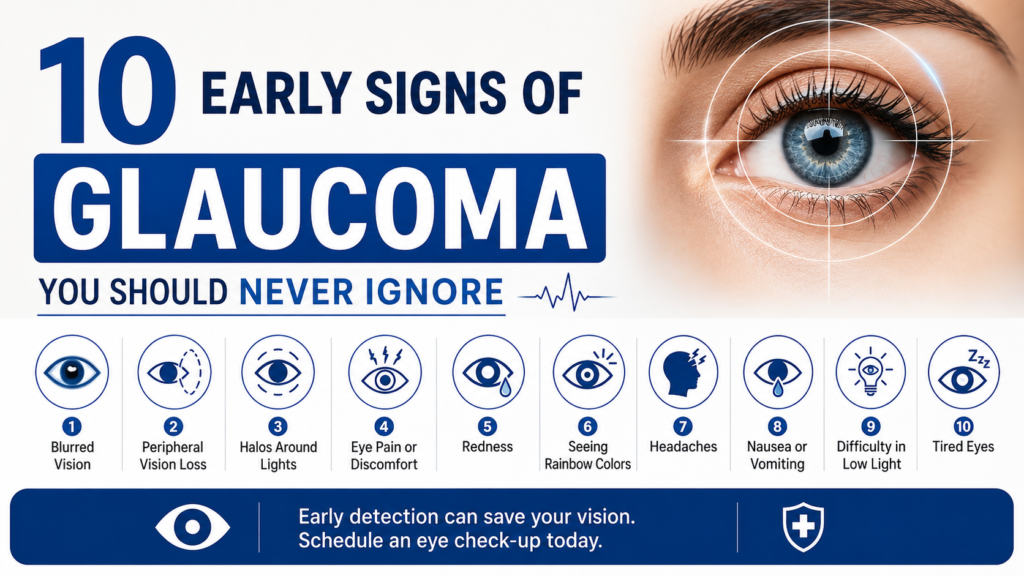
10 early signs of glaucoma infographic showing blurred vision, peripheral vision loss, eye pain, halos around lights, and other symptoms by Dr. Ruchi Eye Clinic Faridabad
Uncategorized

10 Early Signs of Glaucoma You Should Never Ignore

Imagine waking up every morning, reading your phone, driving to work, or watching your children play without noticing that your eyesight is slowly changing. Everything seems normal because your central vision is still clear. However, around the edges, your vision may already be disappearing little by little. This is exactly why glaucoma is often called the “Silent Thief of Sight.” It usually develops without pain and without obvious warning signs. Many people only discover the disease after permanent vision loss has already occurred. The most worrying part is that vision lost due to glaucoma cannot usually be restored. The good news is that early diagnosis can help slow or prevent further vision loss. That’s why regular Glaucoma Treatment in Faridabad begins with timely eye examinations and proper diagnostic testing. At Dr. Ruchi Eye Clinic, patients receive comprehensive glaucoma evaluations using modern diagnostic technology under the guidance of Dr. Ruchi Pahuja, who has more than 30 years of clinical experience in ophthalmology. The clinic focuses on early detection, personalized care, and long-term monitoring to help protect healthy vision. If you have ever delayed an Eye Check-up in Faridabad because your eyes “feel fine,” this article is for you. What Is Glaucoma and Why Do So Many People Miss It? Glaucoma is a group of eye diseases that damage the optic nerve, which carries visual information from your eyes to your brain. Most people think that glaucoma always causes pain or sudden blindness. In reality, the most common type develops very slowly. During the early stages, you may continue reading, driving, and working without realizing that your side vision is gradually disappearing. That is why thousands of people discover glaucoma only after significant vision has already been lost. Many patients tell us: “I thought my eyesight was normal.” “I didn’t notice anything unusual.” “I only came because someone asked me to get my eyes checked.” Unfortunately, glaucoma often gives people very little warning. Regular visits to an Eye Specialist in Faridabad are one of the best ways to identify glaucoma before it causes permanent damage. Why Is Glaucoma Called the Silent Thief of Sight? Think about locking your home every night. If someone quietly removed one brick every day, you probably wouldn’t notice at first. Weeks later, the wall would become weak, even though everything looked normal in the beginning. Glaucoma behaves in a similar way. Instead of suddenly affecting your vision, it slowly damages the optic nerve over time. Your brain naturally adjusts to the gradual vision loss. As a result, many people never realize anything is wrong until the disease has already reached an advanced stage. This is why delaying Glaucoma Treatment in Faridabad can be risky. Without early diagnosis: Side vision slowly disappears. Daily activities become difficult. Driving becomes less safe. Reading may become harder. Permanent blindness may eventually occur. The reassuring news is that regular eye examinations can detect glaucoma before these serious problems develop. At Dr. Ruchi Eye Clinic, modern investigations such as OCT Scan, Eye Pressure Testing, Visual Field Testing, and Fundus Imaging help identify glaucoma during its earliest stages. Could You Have Glaucoma Without Knowing It? The simple answer is yes. Many patients with glaucoma experience no symptoms for several years. You may continue your normal routine while the disease quietly damages your optic nerve. Ask yourself these questions: Do you often bump into objects beside you? Have you started turning your head more while walking? Do you struggle to notice people approaching from the side? Does driving at night feel different than before? Have family members mentioned that you seem to miss things around you? These changes are often very gradual, making them easy to ignore. That is why Glaucoma Treatment in Faridabad always begins with proper diagnosis rather than waiting for symptoms to become severe. If you are above 40 years of age, have diabetes, high blood pressure, or a family history of glaucoma, scheduling an Eye Check-up in Faridabad is one of the most important steps you can take to protect your vision. 1. Are You Slowly Losing Your Side Vision? This is one of the earliest and most common signs of glaucoma. Unlike blurred central vision, side vision usually disappears so gradually that people rarely notice the change. Imagine walking through your home and occasionally brushing against a chair. Or driving and failing to notice a vehicle approaching from the side. These situations may seem unimportant at first. However, they could indicate that your peripheral vision is becoming smaller. Many patients only realize this after the condition has progressed. If you notice changes in your side vision, do not ignore them. A comprehensive examination by an experienced Glaucoma Specialist in Faridabad can identify the cause before more vision is affected. 2. Do You Frequently Experience Blurred Vision? Blurred vision does not always mean you need stronger glasses. Sometimes it may be related to glaucoma or another eye condition affecting the optic nerve. Perhaps you notice that reading becomes difficult during the evening. Maybe road signs look unclear while driving. Or your eyes take longer to focus after using a computer. Although blurred vision has many possible causes, it should never be ignored. At Dr. Ruchi Eye Clinic, every patient receives a detailed examination to determine whether glaucoma, cataracts, refractive errors, retinal disease, or another condition is responsible for the symptoms. Early diagnosis allows Glaucoma Treatment in Faridabad to begin before permanent vision loss develops. 3. Do You See Halos Around Lights at Night? Have you ever looked at a streetlight or the headlights of an oncoming vehicle and noticed colorful rings around the light? Occasional halos may occur for several reasons. However, when they appear repeatedly or are associated with eye pain, blurred vision, or headaches, they should be evaluated promptly. Some types of glaucoma can increase eye pressure rapidly and produce symptoms such as: Halos around lights Blurred vision Eye pain Nausea Severe headache These symptoms require immediate medical attention. Visiting an Eye Specialist in Faridabad without delay can help prevent serious damage to the optic nerve. At Dr. Ruchi Eye Clinic, advanced glaucoma investigations help determine whether elevated eye pressure or another eye condition is causing

Scroll to Top